 Add to Chrome
 Add to Firefox
 Add to Edge
Lyapunov Stability-Aware Stackelberg Game for Low-Altitude Economy: A Control-Oriented Pruning-Based DRL Approach
Feb 01, 2026
With the rapid expansion of the low-altitude economy, Unmanned Aerial Vehicles (UAVs) serve as pivotal aerial base stations supporting diverse services from users, ranging from latency-sensitive critical missions to bandwidth-intensive data streaming. However, the efficacy of such heterogeneous networks is often compromised by the conflict between limited onboard resources and stringent stability requirements. Moving beyond traditional throughput-centric designs, we propose a Sensing-Communication-Computing-Control closed-loop framework that explicitly models the impact of communication latency on physical control stability. To guarantee mission reliability, we leverage the Lyapunov stability theory to derive an intrinsic mapping between the state evolution of the control system and communication constraints, transforming abstract stability requirements into quantifiable resource boundaries. Then, we formulate the resource allocation problem as a Stackelberg game, where UAVs (as leaders) dynamically price resources to balance load and ensure stability, while users (as followers) optimize requests based on service urgency. Furthermore, addressing the prohibitive computational overhead of standard Deep Reinforcement Learning (DRL) on energy-constrained edge platforms, we propose a novel and lightweight pruning-based Proximal Policy Optimization (PPO) algorithm. By integrating a dynamic structured pruning mechanism, the proposed algorithm significantly compresses the neural network scale during training, enabling the UAV to rapidly approximate the game equilibrium with minimal inference latency. Simulation results demonstrate that the proposed scheme effectively secures control loop stability while maximizing system utility in dynamic low-altitude environments.

ComAgent: Multi-LLM based Agentic AI Empowered Intelligent Wireless Networks
Jan 27, 2026Emerging 6G networks rely on complex cross-layer optimization, yet manually translating high-level intents into mathematical formulations remains a bottleneck. While Large Language Models (LLMs) offer promise, monolithic approaches often lack sufficient domain grounding, constraint awareness, and verification capabilities. To address this, we present ComAgent, a multi-LLM agentic AI framework. ComAgent employs a closed-loop Perception-Planning-Action-Reflection cycle, coordinating specialized agents for literature search, coding, and scoring to autonomously generate solver-ready formulations and reproducible simulations. By iteratively decomposing problems and self-correcting errors, the framework effectively bridges the gap between user intent and execution. Evaluations demonstrate that ComAgent achieves expert-comparable performance in complex beamforming optimization and outperforms monolithic LLMs across diverse wireless tasks, highlighting its potential for automating design in emerging wireless networks.
Cross-reality Location Privacy Protection in 6G-enabled Vehicular Metaverses: An LLM-enhanced Hybrid Generative Diffusion Model-based Approach
Jan 18, 2026The emergence of 6G-enabled vehicular metaverses enables Autonomous Vehicles (AVs) to operate across physical and virtual spaces through space-air-ground-sea integrated networks. The AVs can deploy AI agents powered by large AI models as personalized assistants, on edge servers to support intelligent driving decision making and enhanced on-board experiences. However, such cross-reality interactions may cause serious location privacy risks, as adversaries can infer AV trajectories by correlating the location reported when AVs request LBS in reality with the location of the edge servers on which their corresponding AI agents are deployed in virtuality. To address this challenge, we design a cross-reality location privacy protection framework based on hybrid actions, including continuous location perturbation in reality and discrete privacy-aware AI agent migration in virtuality. In this framework, a new privacy metric, termed cross-reality location entropy, is proposed to effectively quantify the privacy levels of AVs. Based on this metric, we formulate an optimization problem to optimize the hybrid action, focusing on achieving a balance between location protection, service latency reduction, and quality of service maintenance. To solve the complex mixed-integer problem, we develop a novel LLM-enhanced Hybrid Diffusion Proximal Policy Optimization (LHDPPO) algorithm, which integrates LLM-driven informative reward design to enhance environment understanding with double Generative Diffusion Models-based policy exploration to handle high-dimensional action spaces, thereby enabling reliable determination of optimal hybrid actions. Extensive experiments on real-world datasets demonstrate that the proposed framework effectively mitigates cross-reality location privacy leakage for AVs while maintaining strong user immersion within 6G-enabled vehicular metaverse scenarios.
Land-then-transport: A Flow Matching-Based Generative Decoder for Wireless Image Transmission
Jan 12, 2026Due to strict rate and reliability demands, wireless image transmission remains difficult for both classical layered designs and joint source-channel coding (JSCC), especially under low latency. Diffusion-based generative decoders can deliver strong perceptual quality by leveraging learned image priors, but iterative stochastic denoising leads to high decoding delay. To enable low-latency decoding, we propose a flow-matching (FM) generative decoder under a new land-then-transport (LTT) paradigm that tightly integrates the physical wireless channel into a continuous-time probability flow. For AWGN channels, we build a Gaussian smoothing path whose noise schedule indexes effective noise levels, and derive a closed-form teacher velocity field along this path. A neural-network student vector field is trained by conditional flow matching, yielding a deterministic, channel-aware ODE decoder with complexity linear in the number of ODE steps. At inference, it only needs an estimate of the effective noise variance to set the ODE starting time. We further show that Rayleigh fading and MIMO channels can be mapped, via linear MMSE equalization and singular-value-domain processing, to AWGN-equivalent channels with calibrated starting times. Therefore, the same probability path and trained velocity field can be reused for Rayleigh and MIMO without retraining. Experiments on MNIST, Fashion-MNIST, and DIV2K over AWGN, Rayleigh, and MIMO demonstrate consistent gains over JPEG2000+LDPC, DeepJSCC, and diffusion-based baselines, while achieving good perceptual quality with only a few ODE steps. Overall, LTT provides a deterministic, physically interpretable, and computation-efficient framework for generative wireless image decoding across diverse channels.
U-MASK: User-adaptive Spatio-Temporal Masking for Personalized Mobile AI Applications
Jan 11, 2026Personalized mobile artificial intelligence applications are widely deployed, yet they are expected to infer user behavior from sparse and irregular histories under a continuously evolving spatio-temporal context. This setting induces a fundamental tension among three requirements, i.e., immediacy to adapt to recent behavior, stability to resist transient noise, and generalization to support long-horizon prediction and cold-start users. Most existing approaches satisfy at most two of these requirements, resulting in an inherent impossibility triangle in data-scarce, non-stationary personalization. To address this challenge, we model mobile behavior as a partially observed spatio-temporal tensor and unify short-term adaptation, long-horizon forecasting, and cold-start recommendation as a conditional completion problem, where a user- and task-specific mask specifies which coordinates are treated as evidence. We propose U-MASK, a user-adaptive spatio-temporal masking method that allocates evidence budgets based on user reliability and task sensitivity. To enable mask generation under sparse observations, U-MASK learns a compact, task-agnostic user representation from app and location histories via U-SCOPE, which serves as the sole semantic conditioning signal. A shared diffusion transformer then performs mask-guided generative completion while preserving observed evidence, so personalization and task differentiation are governed entirely by the mask and the user representation. Experiments on real-world mobile datasets demonstrate consistent improvements over state-of-the-art methods across short-term prediction, long-horizon forecasting, and cold-start settings, with the largest gains under severe data sparsity. The code and dataset will be available at https://github.com/NICE-HKU/U-MASK.
Sum-Rate Maximization for Uplink Segmented Waveguide-Enabled Pinching-Antenna Systems
Dec 23, 2025A multiuser uplink transmission framework based on the segmented waveguide-enabled pinching-antenna system (SWAN) is proposed under two operating protocols: segment selection (SS) and segment aggregation (SA). For each protocol, the achievable uplink sum-rate is characterized for both time-division multiple access (TDMA) and non-orthogonal multiple access (NOMA). Low-complexity placement methods for the pinching antennas (PAs) are developed for both protocols and for both multiple-access schemes. Numerical results validate the effectiveness of the proposed methods and show that SWAN achieves higher sum-rate performance than conventional pinching-antenna systems, while SA provides additional performance gains over SS.
Cost Minimization for Space-Air-Ground Integrated Multi-Access Edge Computing Systems
Oct 24, 2025Space-air-ground integrated multi-access edge computing (SAGIN-MEC) provides a promising solution for the rapidly developing low-altitude economy (LAE) to deliver flexible and wide-area computing services. However, fully realizing the potential of SAGIN-MEC in the LAE presents significant challenges, including coordinating decisions across heterogeneous nodes with different roles, modeling complex factors such as mobility and network variability, and handling real-time decision-making under partially observable environment with hybrid variables. To address these challenges, we first present a hierarchical SAGIN-MEC architecture that enables the coordination between user devices (UDs), uncrewed aerial vehicles (UAVs), and satellites. Then, we formulate a UD cost minimization optimization problem (UCMOP) to minimize the UD cost by jointly optimizing the task offloading ratio, UAV trajectory planning, computing resource allocation, and UD association. We show that the UCMOP is an NP-hard problem. To overcome this challenge, we propose a multi-agent deep deterministic policy gradient (MADDPG)-convex optimization and coalitional game (MADDPG-COCG) algorithm. Specifically, we employ the MADDPG algorithm to optimize the continuous temporal decisions for heterogeneous nodes in the partially observable SAGIN-MEC system. Moreover, we propose a convex optimization and coalitional game (COCG) method to enhance the conventional MADDPG by deterministically handling the hybrid and varying-dimensional decisions. Simulation results demonstrate that the proposed MADDPG-COCG algorithm significantly enhances the user-centric performances in terms of the aggregated UD cost, task completion delay, and UD energy consumption, with a slight increase in UAV energy consumption, compared to the benchmark algorithms. Moreover, the MADDPG-COCG algorithm shows superior convergence stability and scalability.
Joint AoI and Handover Optimization in Space-Air-Ground Integrated Network
Sep 16, 2025Despite the widespread deployment of terrestrial networks, providing reliable communication services to remote areas and maintaining connectivity during emergencies remains challenging. Low Earth orbit (LEO) satellite constellations offer promising solutions with their global coverage capabilities and reduced latency, yet struggle with intermittent coverage and limited communication windows due to orbital dynamics. This paper introduces an age of information (AoI)-aware space-air-ground integrated network (SAGIN) architecture that leverages a high-altitude platform (HAP) as intelligent relay between the LEO satellites and ground terminals. Our three-layer design employs hybrid free-space optical (FSO) links for high-capacity satellite-to-HAP communication and reliable radio frequency (RF) links for HAP-to-ground transmission, and thus addressing the temporal discontinuity in LEO satellite coverage while serving diverse user priorities. Specifically, we formulate a joint optimization problem to simultaneously minimize the AoI and satellite handover frequency through optimal transmit power distribution and satellite selection decisions. This highly dynamic, non-convex problem with time-coupled constraints presents significant computational challenges for traditional approaches. To address these difficulties, we propose a novel diffusion model (DM)-enhanced dueling double deep Q-network with action decomposition and state transformer encoder (DD3QN-AS) algorithm that incorporates transformer-based temporal feature extraction and employs a DM-based latent prompt generative module to refine state-action representations through conditional denoising. Simulation results highlight the superior performance of the proposed approach compared with policy-based methods and some other deep reinforcement learning (DRL) benchmarks.
Toward Multi-Functional LAWNs with ISAC: Opportunities, Challenges, and the Road Ahead
Aug 24, 2025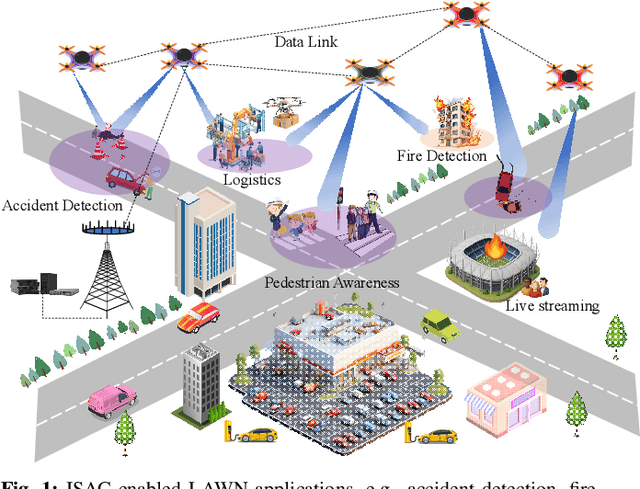
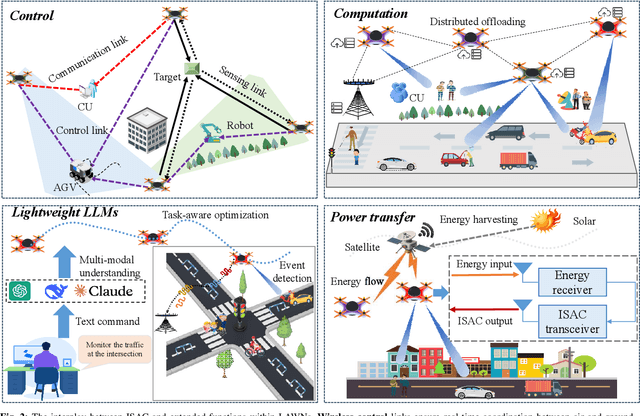
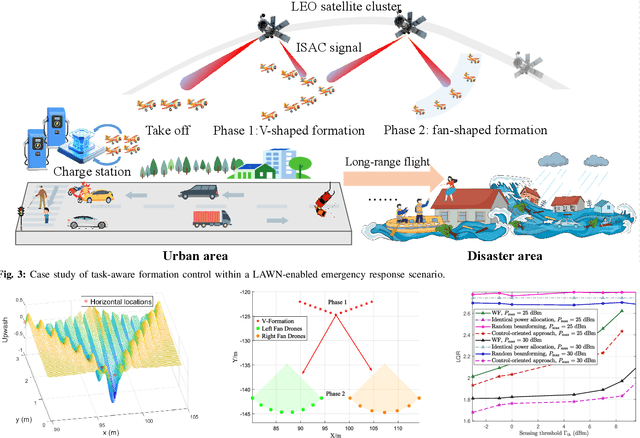
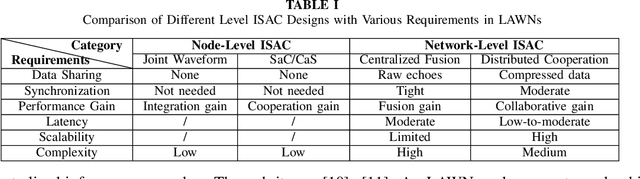
Integrated sensing and communication (ISAC) has been envisioned as a foundational technology for future low-altitude wireless networks (LAWNs), enabling real-time environmental perception and data exchange across aerial-ground systems. In this article, we first explore the roles of ISAC in LAWNs from both node-level and network-level perspectives. We highlight the performance gains achieved through hierarchical integration and cooperation, wherein key design trade-offs are demonstrated. Apart from physical-layer enhancements, emerging LAWN applications demand broader functionalities. To this end, we propose a multi-functional LAWN framework that extends ISAC with capabilities in control, computation, wireless power transfer, and large language model (LLM)-based intelligence. We further provide a representative case study to present the benefits of ISAC-enabled LAWNs and the promising research directions are finally outlined.
Advancing the Control of Low-Altitude Wireless Networks: Architecture, Design Principles, and Future Directions
Aug 11, 2025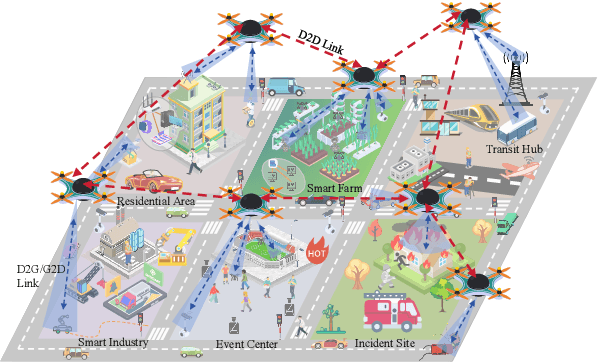

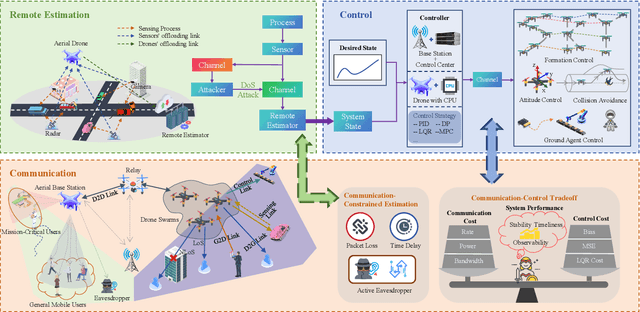
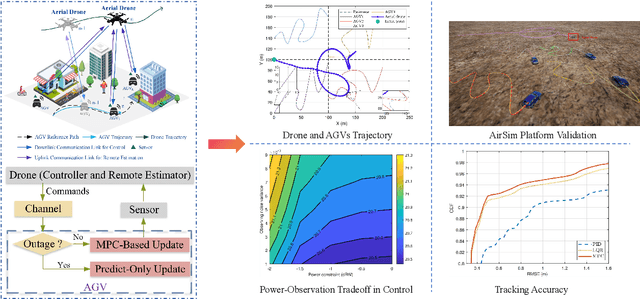
This article introduces a control-oriented low-altitude wireless network (LAWN) that integrates near-ground communications and remote estimation of the internal system state. This integration supports reliable networked control in dynamic aerial-ground environments. First, we introduce the network's modular architecture and key performance metrics. Then, we discuss core design trade-offs across the control, communication, and estimation layers. A case study illustrates closed-loop coordination under wireless constraints. Finally, we outline future directions for scalable, resilient LAWN deployments in real-time and resource-constrained scenarios.